SEO vs Google Ads: Which One is Better for Your Business?
Published: 2026-05-28 06:58:33
When it comes to growing your business online, two of the most powerful strategies are Search Engine Optimization (SEO) and Google Ads (PPC). Both can drive traffic, leads, and sales, but they work in very different ways.
If you’re confused about which one to choose, this guide will break it down with real use cases, comparisons, and practical insights so you can make the right decision for your business.
Should you invest in SEO (Search Engine Optimization) or Google Ads (PPC)?
Both are powerful digital marketing strategies, but they work differently. Choosing the wrong one can waste time and money, while choosing the right strategy can scale your business rapidly.
- In this complete SEO-optimized guide, you’ll learn:
- Difference between SEO and Google Ads
- Real-world use cases
- Cost comparison
- Which strategy is best for your business
- Expert tips to maximize ROI
Let’s break it down step by step.
Businesses looking to scale with automation should explore how an AI powered digital marketing agency in India is transforming modern campaigns.
What is SEO?
SEO (Search Engine Optimization) is the process of improving your website’s visibility on search engines like Google organically (without paying for clicks).
Instead of paying for traffic, you earn rankings by optimizing your website content, structure, and authority.
How SEO Works
SEO focuses on:
- Keyword optimization
- Content creation
- Technical improvements
- Backlink building
When done correctly, your website ranks higher on search results and attracts free, consistent traffic.
Benefits of SEO
1. Long-Term Traffic Growth
Once your website ranks, you can get traffic for months or even years without paying per click.
2. High Trust & Credibility
Users trust organic results more than ads.
3. Better ROI Over Time
SEO takes time, but the return is massive once rankings improve.
4. Brand Authority
Ranking on top positions makes your brand look more reliable and professional.
Example: Imagine you run a digital marketing agency in Delhi.
If your website ranks for:
- “best digital marketing agency in Delhi”
- “SEO services near me”
You’ll get daily organic leads without paying for ads.
For a complete branding strategy, partnering with an integrated PR marketing digital branding agency can deliver long-term growth.
What is Google Ads?
Google Ads is a paid advertising platform that allows businesses to appear at the top of search results instantly.
You pay only when someone clicks your ad—this is called Pay-Per-Click (PPC).
How Google Ads Works
- You select keywords
- Create ads
- Set budget
- Bid for placement
Your ads appear above organic results immediately.
Benefits of Google Ads
1. Instant Results
You can start getting traffic within hours.
2. Highly Targeted Audience
Target users based on:
- Location
- Device
- Behavior
3. Scalable Campaigns
Increase budget to scale results quickly.
4. Measurable ROI
Track clicks, conversions, and performance easily.
Example: If you run an eCommerce store selling shoes, you can run ads for:
- “buy shoes online”
Your ad appears instantly at the top and starts generating sales.
If you're searching for reliable experts, check out the best digital marketing agency in Delhi NCR 2026 to find top service providers.
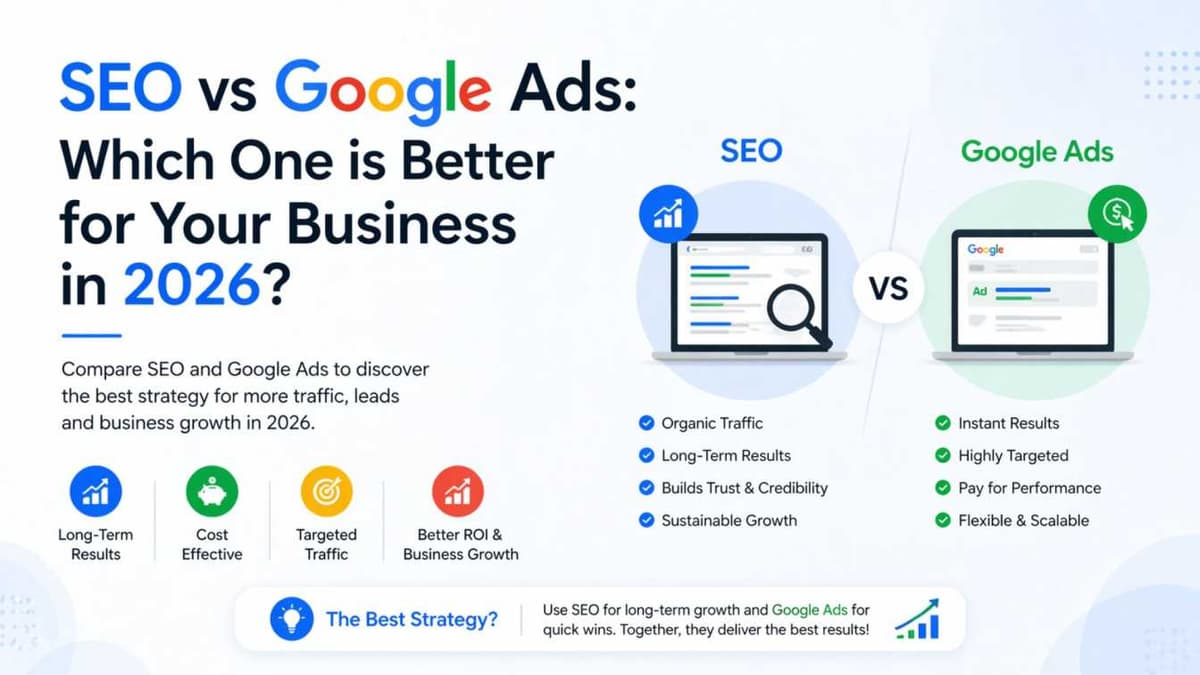
SEO vs Google Ads: Detailed Comparison
| Factor | SEO (Search Engine Optimization) | Google Ads (PPC) |
|---|---|---|
| 1. Cost Comparison | Investment in content, backlinks, and optimization No cost per click -Long-term affordable strategy | Pay for every click Cost per click in India: ₹10 to ₹500+ -Expensive in competitive niches |
| 2. Speed of Results | Takes 3–6 months to show results | Instant visibility and traffic -Ads win in speed |
| 3. Sustainability | Long-lasting results even without ongoing spend | Stops generating traffic when the budget ends -SEO wins in sustainability |
| 4. Trust Factor | High credibility as users trust organic results more | Users may skip ads or trust them less -SEO builds more trust |
| 5. ROI (Return on Investment) | Higher ROI over time with consistent traffic | Faster ROI but requires continuous investment -Depends on business goals |
When Should You Choose SEO?
Choosing SEO (Search Engine Optimization) is not just about ranking on Google—it’s about building a long-term, sustainable growth engine for your business. Below are detailed, real-world scenarios to help you understand exactly when SEO is the right choice.
Scenario 1: Long-Term Growth & Brand Building
If your goal is to create a strong online presence that generates consistent traffic over time, SEO is the best investment.
Why SEO Works Here
- Builds authority in your niche
- Generates recurring traffic without paying per click
- Improves brand visibility and trust
Detailed Example
Imagine you run a digital marketing institute in Delhi.
Instead of spending daily on ads, you create SEO-optimized pages targeting keywords like:
- “digital marketing course in Delhi”
- “best digital marketing institute near me”
- “online marketing course with placement”
You publish:
- Blog guides
- Course landing pages
- Student success stories
Result:
- Within 4–6 months, your pages start ranking
- You get daily organic traffic
- Leads come without ongoing ad spend
-Over time, your brand becomes a top authority in your niche.
Content creators can boost engagement by learning how to create Instagram reels using AI for better reach.
Scenario 2: Budget Constraints (Low Investment Strategy)
If you’re a startup or small business with a limited marketing budget, SEO is a smarter choice than paid ads.
Why SEO is Cost-Effective
- No cost per click
- Content works as a long-term asset
- One-time investment → continuous returns
Detailed Example
Let’s say you own a local bakery in Delhi.
Instead of spending ₹20,000/month on ads, you invest in:
- Google Business Profile optimization
- Local SEO keywords like:
- “best bakery near me”
- “custom cakes in Delhi”
- Blog content:
- “Top 10 birthday cake ideas”
- “Best eggless cakes in Delhi”
Result:
- Your business starts appearing in local searches
- You get free traffic from nearby customers
- Calls and walk-ins increase
-You save money while still growing consistently
Stay updated with the latest innovations by reading the AI Summit 2026 highlights shaping the marketing industry.
Scenario 3: Content-Based Businesses (Blogs, Education, Services)
If your business relies on content, education, or information, SEO is your biggest growth driver.
Why SEO Dominates Here
- Content ranks for multiple keywords
- One article can bring traffic for years
- Ideal for blogs, coaching, SaaS, and agencies
Detailed Example
Let’s say you run an education blog or training institute.
You write SEO-focused articles like:
- “How to start digital marketing career in 2026”
- “SEO vs Google Ads: Which is better?”
- “Digital marketing course fees in India”
Traffic Potential Example
Target keyword:
-“digital marketing course in Delhi”
- Monthly searches: High
- Competition: Medium to high
If your blog ranks on page 1:
- You can get 2,000–10,000 monthly visitors
- Even a 2–5% conversion rate = 50–300 leads/month
Bonus Scenario: Service-Based Businesses
SEO works exceptionally well for:
- Digital marketing agencies
- Web development companies
- Consultants & freelancers
A web development company targets:
- “website development company in Delhi”
- “eCommerce website cost in India”
Creates:
- Service pages
- Blog content
- Case studies
Result:
- Ranks on Google
- Gets inbound leads regularly
- Reduces dependency on paid ads
Marketers can improve creativity using these Gemini prompts trends tools and creative strategies for smarter campaigns.
But with search evolving rapidly in 2026, many businesses are now asking a bigger question: Is SEO really better for long-term growth, or are newer search strategies changing the future of online visibility?
SEO + Google Ads: The Best Strategy for Maximum Growth
If you’re still thinking in terms of SEO vs Google Ads, you’re missing the bigger opportunity. The real winners in digital marketing don’t choose one, they combine both to create a powerful, full-funnel growth system.
Using SEO (organic traffic) and Google Ads (paid traffic) together allows you to capture users at every stage of their journey—from awareness to purchase, while maximizing ROI.
Conclusion
In 2026, digital marketing success depends on strategy, not just tools.
- SEO builds your foundation
- Google Ads drives immediate growth
Businesses that rely only on ads keep paying forever.
Businesses that rely only on SEO grow slowly.
-Smart businesses use both.
If your goal is consistent traffic, better conversions, and higher ROI, combining SEO and Google Ads is the ultimate strategy.
To generate quality leads, this guide on PPC ads strategy explains how to run high-converting ads.
Frequently Asked Questions:
1. Which is better: SEO or Google Ads?
Both are effective. SEO is better for long-term growth, while Google Ads is better for quick results.
2. Is SEO cheaper than Google Ads?
Yes, SEO is more cost-effective in the long run because you don’t pay per click.
3. Can I use SEO and Google Ads together?
Yes, combining both gives the best results.
4. How long does SEO take?
Usually 3–6 months to see significant results.
5. Are Google Ads worth it?
Yes, especially for businesses that need instant leads and sales.