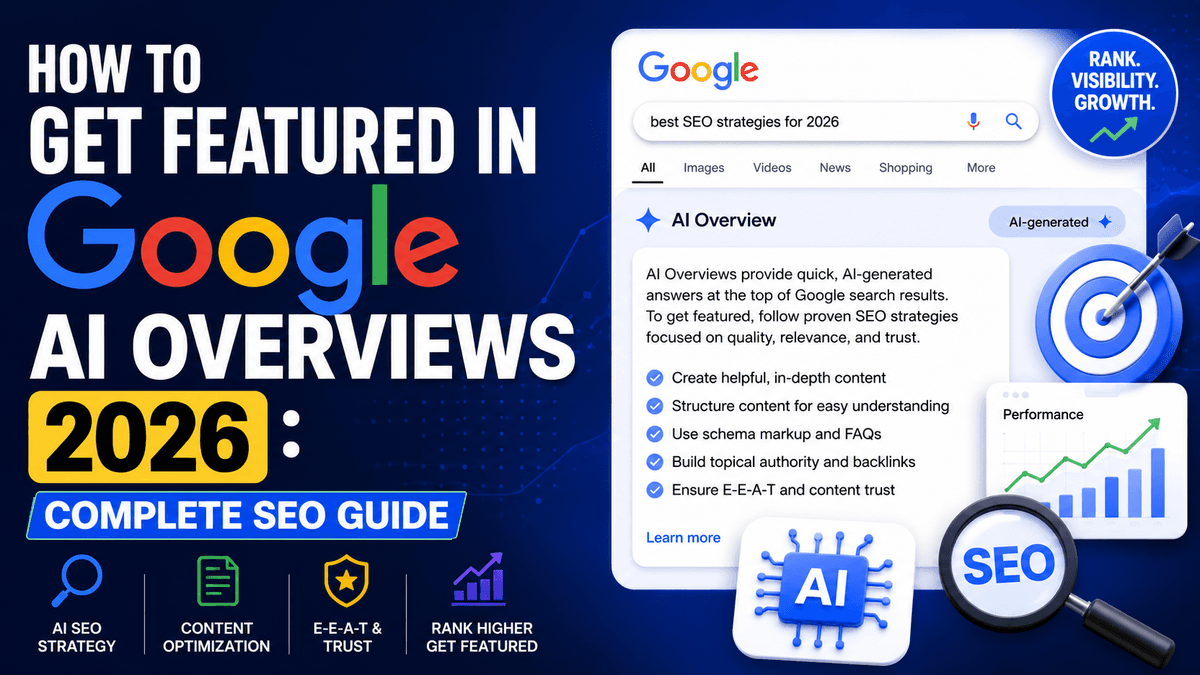
How to Get Featured in Google AI Overviews 2026: Complete SEO Guide
Published: 2026-07-08 13:26:53
Search has quietly changed shape. For a growing share of queries, the first thing a user sees isn't a list of blue links — it's an AI-written summary sitting above everything else, pulling together answers from a handful of sources and citing them directly. That block is a Google AI Overview, and whether your brand appears inside it is quickly becoming as important as ranking on page one ever was.
This guide breaks down how to get featured in Google AI Overviews 2026, based on patterns observed across large-scale citation research, Google's own documentation on quality content, and what's actually working for brands appearing consistently in AI-generated answers. Whether you're running a blog, an ecommerce store, or a local business, you'll find a practical SEO checklist for Google AI Overviews 2026 you can start applying today.
If your Google rankings dropped after the June 2026 update, learn how to identify the real cause and start recovering your organic traffic.
What Are Google AI Overviews, and Why They Matter in 2026
Google AI Overviews are AI-generated answer blocks that appear at the top of search results, synthesizing information from multiple sources — typically five to six different websites — into a single, original response with embedded citations. Unlike the older featured snippet format, which quoted one source verbatim, AI Overviews write a new answer and decide which sites earn a mention.
By 2026, this feature reaches billions of searches globally and appears on a large and growing share of informational, comparison, and "how to" queries. For B2B, ecommerce, and local businesses alike, this means a meaningful portion of buyers now form their first impression of your brand — or never learn it exists — based on whether Google's AI decided to cite you.
The practical effect is twofold. Traditional organic click-through rates fall when an AI Overview appears, since many users get their answer without visiting any site. But brands that do get cited inside the Overview tend to see higher-quality, higher-converting traffic than average organic clicks — because the user arrives already informed and further along in their decision. In short: how to rank in Google AI Overviews 2026 is no longer a nice-to-have question. It's the question.
Want to understand what is Generative Engine Optimization (GEO)? Explore our complete guide to optimizing your brand for AI-powered search.
How Google Selects Sources for AI Overviews
Google hasn't published an exact formula for Google AI Overview ranking factors in 2026, but consistent patterns show up across research into thousands of cited pages:
- Topical breadth. Google's system expands a query into related "fan-out" sub-questions and favors pages — or entire sites — that rank across several of those related queries, not just the single head keyword.
- Domain and page-level authority. Google's E-E-A-T framework (Experience, Expertise, Authoritativeness, Trustworthiness) functions as a credibility filter, evaluating both the individual page and the site's overall track record on the topic.
- Third-party validation. Independent coverage, mentions, and citations from other reputable sites and publications strengthen a domain's standing far more than self-published claims alone.
- Extractable structure. Content that opens each section with a clear, direct answer — rather than long preamble — gives Google's system something concrete to lift into a citation.
- Freshness. Recently published or recently updated content, especially on fast-moving topics, tends to outperform older pages carrying the same information.
Understanding how Google selects sources for AI Overviews reframes the strategy question. It's less about chasing a single keyword and more about becoming the source that can't be left out of the conversation on a topic.
Learn how local businesses can appear in AI answers by optimizing your online presence for AI-powered search platforms.
Content Optimization for Google AI Overviews 2026: The Core Framework
If you're wondering how to optimize content for Google AI Overviews, the answer sits at the intersection of structure, authority, and freshness. Here's the practical framework.
1. Lead With the Direct Answer
Every major section of your content should open with a concise, self-contained answer — roughly 40 to 60 words — that could be lifted out of context and still make sense. This is the exact structure AI systems look for when deciding what to cite. Save the nuance, examples, and deeper explanation for after that opening answer, not before it.
2. Structure Around Real Questions
Use question-based H2 and H3 headings that mirror how people actually search — this is core to how to structure content for Google AI Overviews. Instead of a heading like "Optimization Considerations," use "How Do I Optimize My Website for AI Search Results?" Google's fan-out system is quite literally built around related questions, so content organized the same way is easier to match.
Want to know how to rank in ChatGPT? Discover proven GEO strategies to increase your brand's visibility in AI search.
3. Build Topical Clusters, Not Isolated Pages
A single well-written article rarely earns sustained citation on its own. Sites that consistently appear in AI Overviews tend to have a cluster of interlinked content around a topic: one comprehensive pillar page, several supporting articles addressing related sub-questions, and FAQ content addressing long-tail queries. This is the foundation of how to build topical authority for AI Overviews — depth beats a single optimized page every time.
4. Apply E-E-A-T Consistently
E-E-A-T strategies for Google AI Overviews 2026 should include named, credentialed authors where relevant; original data, case studies, or first-hand experience rather than recycled generalities; transparent sourcing with links to credible references; and a consistent, verifiable presence across your website, social profiles, and business listings. Google's own guidance on creating helpful, reliable, people-first content remains the foundation this framework is built on — worth reviewing directly if you haven't already, alongside the general Google quality content guidelines it's part of.
5. Use Schema Markup Deliberately
Does structured data help Google AI Overviews? Yes — and it's one of the highest-leverage technical changes you can make. Focus on:
- FAQPage schema for question-and-answer sections, since it pre-formats content into the exact shape AI systems extract from
- HowTo schema for step-by-step processes and guides
- Article schema with proper author attribution
- Organization schema linking your brand consistently across your website, social profiles, and directories
Knowing how to use schema markup for Google AI Overviews correctly means keeping it accurate, matching it to visible on-page content, and validating it before publishing — mismatched or invented schema does more harm than good.
Wondering SEO vs GEO marketing? Learn the key differences and how both strategies work together for AI search success.
6. Keep Content Fresh
Build a quarterly review cycle into your content operations. Update statistics, add recent developments, and refresh publish dates on your best-performing pages. Static content — even excellent content — steadily loses ground to more recently updated competitors on time-sensitive topics.
SEO Checklist for Google AI Overviews 2026
Use this as a working SEO checklist for Google AI Overviews 2026 before and after publishing:
- [ ] Target a specific question, not just a head keyword
- [ ] Open each section with a direct, self-contained answer
- [ ] Use question-based headings throughout
- [ ] Include original data, examples, or first-hand insight
- [ ] Add a well-structured FAQ section with FAQPage schema
- [ ] Link the piece into a broader topic cluster on your site
- [ ] Ensure fast page load and mobile-friendly rendering (Core Web Vitals still matter)
- [ ] Attribute claims to credible sources with outbound links
- [ ] Keep author and business information consistent across the web
- [ ] Set a recurring schedule to refresh statistics and dates
Learn what is a performance marketing agency in India and how it drives measurable business growth.
How to Make Your Website Eligible for Google AI Overviews
Beyond individual articles, there's a baseline of technical and structural readiness that determines how to make website eligible for Google AI Overviews in the first place:
- Get properly indexed. If Google can't crawl and index your pages cleanly, none of the above matters.
- Fix technical debt. Slow load times, broken mobile rendering, and thin or duplicate content all work against you.
- Strengthen internal linking. Clear, descriptive internal links between related pages help Google understand your site's topical structure — and help its systems retrieve the right page for the right sub-query.
- Monitor Google Search Console. While there isn't yet a dedicated AI Search Console report separate from standard performance data, Search Console remains your best free window into how your pages are performing on queries where AI Overviews now appear — watch for pages with steady impressions but falling click-through rate, which often signals an AI Overview has absorbed the click.
Looking for an AI-powered digital marketing agency in India? Discover how AI can accelerate your business growth.
How to Rank Blog Posts in Google AI Overviews
For publishers and content teams specifically working on how to rank blog posts in Google AI Overviews, the same principles apply with a few additions:
- Favor practical, specific guides over generic overviews of a topic — specificity is what makes a passage extractable
- Include comparison tables and numbered steps wherever relevant; both formats are easy for AI systems to parse and cite
- Interlink new posts with your best-performing existing content to reinforce topical depth
- Promote posts beyond your own site — mentions and shares on other platforms build the external validation signal that pure on-site optimization can't replicate on its own
Wondering SEO vs Google Ads? Learn which strategy is best for your business goals.
AI Search Optimization for Ecommerce and Local Businesses
Two categories deserve a specific mention, since AI search optimization strategies for Google 2026 don't look identical across every kind of website.
How to get ecommerce products featured in AI Overviews: Structure product pages with Product and Review schema, write specification-rich descriptions instead of marketing copy alone, and build comparison or buying-guide content around your category — Google frequently cites comparison content for commercial-investigation queries like "best X for Y."
How local businesses can appear in Google AI Overviews: Keep your Google Business Profile complete and current, maintain consistent name, address, and phone details across every directory listing, collect and respond to reviews, and publish locally specific content (neighborhood guides, local FAQs) rather than generic service pages alone.
Build a stronger online presence with our AI-Powered Digital Marketing Agency India services for smarter brand growth.
How to Track and Measure Google AI Overview Visibility
Once you've applied the checklist, you need a way to confirm it's working. Here's how to measure Google AI Overview visibility in practice:
- Manual query testing. Search your priority keywords regularly and record whether an AI Overview appears, and whether your brand is cited.
- Google Search Console. Watch impression-to-click ratio trends on queries known to trigger AI Overviews.
- Referral traffic segmentation. Set up a custom segment in your analytics platform to isolate traffic arriving from AI-generated answers, and compare its conversion rate against standard organic traffic.
- Third-party visibility tools. Several dedicated tools to track rankings in Google AI Overviews have emerged, offering automated citation tracking across AI platforms — useful once you're managing visibility at scale, though manual sampling remains a solid starting point for smaller sites.
If you've noticed falling organic traffic that coincides with AI Overviews appearing on your core queries, how to recover lost traffic from AI Overviews typically comes down to the same fundamentals: tightening topical clusters, adding genuinely original data points competitors don't have, and making sure your content structure gives Google something clean to cite — rather than trying to reverse-engineer a single algorithmic trick.
Looking for the Best Digital Marketing Agency in Delhi NCR 2026? Explore our expert guide to find the right marketing partner for your business.
Why Partner With an Experienced SEO Agency for AI Overview Optimization
Executing all of the above consistently — content restructuring, schema implementation, topical cluster planning, technical fixes, and ongoing measurement — is a lot to manage alongside running an actual business. This is exactly where working with the best AI SEO agency for Google AI Overviews pays off: not by chasing a shortcut, but by applying the framework consistently across your whole content library instead of one article at a time.
Promfly works with businesses across Delhi NCR and beyond as a full-service digital marketing agency offering exactly this kind of Google AI Overviews optimization services 2026 — from technical SEO audits and schema implementation to content strategy built around topical authority, not just keyword volume. If you're looking for a Google AI Overview SEO consultant who can build both the content and the technical foundation your site needs to compete in AI-driven search, Promfly's team combines traditional SEO expertise with the newer GEO (Generative Engine Optimization) practices this guide covers — including SEO audits, on-page optimization, schema implementation, and ongoing SEO reporting to track exactly the kind of visibility shifts covered above. You can also read Promfly's own breakdown of related shifts in what generative engine optimization (GEO) actually is and how local businesses now appear in AI answers.
Frequently Asked Questions
1. How do I get featured in Google AI Overviews in 2026?
Focus on topical depth rather than single keywords, structure content with direct answers up front, use FAQ and Article schema, build genuine authority signals (author credentials, original data, third-party mentions), and keep content updated regularly.
2. What is a Google AI Overviews SEO strategy for 2026?
A modern strategy combines classic technical SEO (site speed, indexing, internal linking) with content structured specifically for AI extraction — question-based headings, concise answer blocks, schema markup, and topic clusters that cover a subject from multiple angles rather than a single page.
3. Does structured data really help with AI Overviews?
Yes. FAQPage, HowTo, Article, and Organization schema make it easier for Google's AI systems to identify exactly what question a section of your page answers, which increases the likelihood of citation.
4. How is AI Overview optimization different from traditional SEO?
Traditional SEO rewards keyword targeting, backlinks, and page-level ranking signals. AI Overview citation weighs topical breadth, content structure for extraction, and third-party authority more heavily — a page doesn't need to rank #1 to be cited, but it does need to be trustworthy and clearly structured.
5. Can small or local businesses realistically appear in AI Overviews?
Yes. Local businesses have a real opportunity by keeping their Google Business Profile complete, maintaining consistent listings across directories, gathering reviews, and publishing locally specific content addressing the exact questions local customers search.
6. How long does it take to start appearing in Google AI Overviews?
There's no fixed timeline. Sites with existing domain authority and consistent content structure can see citations within weeks of publishing optimized content. Newer sites should expect a longer runway — often a few months — while topical authority and third-party signals build up.
7. What tools can I use to track my AI Overview visibility?
Start with Google Search Console to spot impression-to-click shifts on relevant queries, supplement with manual query testing across your priority keywords, and consider dedicated AI-citation tracking tools as your content library scales.
8. Do I need to hire an agency, or can I do this myself?
Smaller sites with a focused topic can absolutely apply this checklist in-house. Larger sites, ecommerce catalogs, or businesses managing multiple locations often benefit from an experienced partner who can execute schema, content structure, and technical fixes consistently across dozens or hundreds of pages.
Learn how to Create Instagram Reels Using AI with step-by-step techniques to produce engaging content faster.
Ready to Get Your Brand Featured in Google AI Overviews?
Our team is ready to assist you. Fill out the form and we'll get back to you promptly.
Call Us: +91 7303881503 Email Us: info@promfly.com Visit Us: 2/81-82, Ground Floor, Lalita Park, Gali No - 2, Laxmi Nagar, New Delhi - 110092
Explore Promfly's full SEO services or browse more insights on the Promfly blog.