

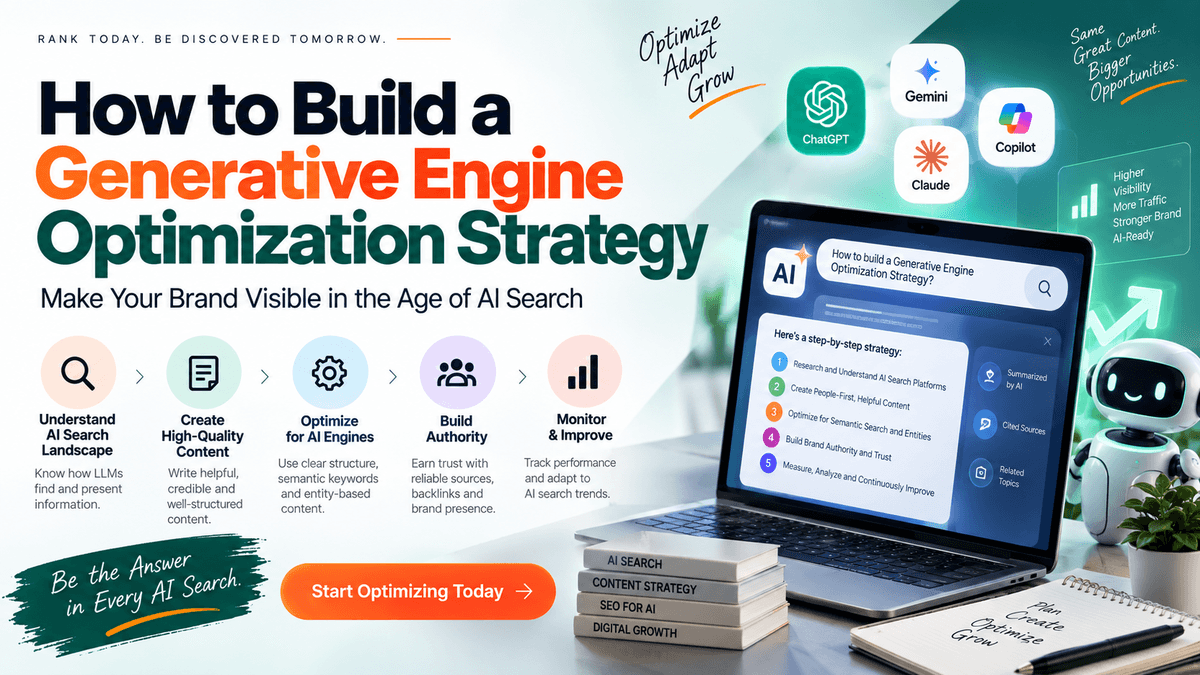
How to Build a Generative Engine Optimization Strategy
Published: 2026-09-16 10:05:00
Search is no longer just about ranking on Google. Increasingly, users are asking full, conversational questions to AI-powered tools like ChatGPT, Google AI Overviews, Perplexity, and Gemini — and expecting a synthesized, ready-made answer in return, often without visiting a single website.
This shift means businesses now need more than a traditional SEO plan. They need a Generative Engine Optimization (GEO) strategy — a structured approach to becoming visible, trusted, and referenced inside AI-generated answers.
This guide walks you through exactly how to build a practical GEO strategy — from research and content creation to technical optimization, authority building, and performance measurement — with real, actionable steps you can start applying today. And if you'd rather have experts handle it for you, Promfly's SEO Services team can build and execute this strategy for your business.
Generative Engine Optimization Services
What Is a Generative Engine Optimization Strategy?
A Generative Engine Optimization strategy is a structured plan that helps your business get recognized, understood, and referenced by AI systems when they generate answers to user queries.
Unlike traditional SEO, which focuses on ranking pages in a list of search results, GEO focuses on becoming a trusted source that AI tools choose to pull information from. It considers how generative search experiences retrieve, synthesize, and present information — and why AI search visibility is becoming a critical consideration for modern businesses.
Importantly, GEO doesn't replace SEO. It builds on it. A strong technical and content SEO foundation makes your GEO efforts significantly more effective.
Learn more about Search Engine Optimization Services for sustainable organic growth.
GEO Strategy vs Traditional SEO Strategy
| Traditional SEO | GEO Strategy |
| Search rankings | AI-generated answer visibility |
| Keywords | Questions, entities, and context |
| SERPs | Generative/answer experiences |
| Organic traffic | Visibility, mentions, and citations |
| Website authority | Broader brand/entity authority |
Why Businesses Need a GEO Strategy
Search Behavior Is Becoming More Conversational
Users are typing (and speaking) full questions rather than fragmented keywords, and AI tools respond with direct, synthesized answers.
AI Can Influence Brand Discovery
When an AI tool names your business as a recommended option, that mention can meaningfully shape a buyer's decision before they ever visit your website.
Users May Get Answers Without Visiting Multiple Websites
Zero-click search behavior is increasing, making it essential for your brand to be part of the answer itself — not just a link beneath it.
Brand Authority Matters Beyond Traditional Rankings
Ranking #1 on Google doesn't guarantee visibility if AI systems are sourcing their answers elsewhere.
GEO Can Complement Existing SEO Efforts
Rather than starting from scratch, GEO strengthens and extends the SEO work you're likely already doing.
Important: No strategy can guarantee specific inclusion or ranking in AI-generated answers — GEO improves your probability of visibility, not a guaranteed outcome.
Explore AI vs Traditional Marketing to understand the key differences between both approaches.
How to Build a Generative Engine Optimization Strategy
Here's a step-by-step framework you can follow to build a practical, results-oriented GEO strategy.
1. Define Your GEO Goals
Start by identifying what you actually want to improve:
- Brand visibility
- Product or service discovery
- AI citations and brand mentions
- Referral traffic
- Qualified leads
- Local visibility
Read our guide on Build a Strong Online Presence for Your Brand.
2. Identify Your Target Audience and Search Questions
Research the real questions your customers ask before making a decision. Group them into categories:
- Informational
- Commercial
- Transactional
- Comparison
- Local
- Problem-solving
Example: Instead of targeting only "SEO agency Delhi," also research questions like "What does an SEO agency do?", "How much does SEO cost in Delhi?", and "Which SEO services do local businesses need?"
3. Analyze Your Current AI Search Visibility
Create a baseline by checking relevant queries across AI-powered search experiences. Record:
- Whether your brand appears
- How your brand is described
- Which competitors appear
- Which sources and pages are cited
- What information is missing or inaccurate
This creates your GEO visibility benchmark.
Explore our guide on Improve SEO Visibility and increase organic reach.
4. Build a Strong Brand Entity
Make your business information consistent everywhere it appears online — your name, description, services, products, locations, team, contact details, and About page. Consistency across authoritative platforms helps AI systems clearly identify who you are.
5. Build Topical Authority
Instead of publishing isolated articles, build a connected content ecosystem around your core subject. For example, a GEO cluster might include: What Is GEO? → How GEO Works → GEO vs SEO → GEO vs AEO → GEO Strategy → GEO Services. You can see this approach in action on our Search Engine Optimization Services page and our guide on what generative engine optimization actually is.
6. Create Content That Answers Specific Questions
Focus on content that is clear, accurate, helpful, well-structured, and up to date. Use definitions, step-by-step processes, comparisons, tables, FAQs, examples, and cited statistics.
7. Optimize Content for Context and Entities
Don't rely on keyword repetition alone. Strengthen relationships between your brand, services, industry, and location — for example: Promfly → SEO Services → Local Businesses → Delhi NCR → Local Search Optimization. This creates clearer contextual signals for AI systems.
8. Strengthen E-E-A-T Signals
Cover first-hand experience, author expertise, transparent company information, real client case studies, original research, and references to reliable sources. Explore our portfolio and client work for real examples of results-driven strategy.
9. Improve Technical SEO
GEO doesn't eliminate the need for a technically strong website. Audit crawlability, indexability, internal linking, page speed, mobile experience, canonicals, sitemaps, and technical SEO fundamentals.
10. Use Structured Data Where Appropriate
Relevant schema markup — Organization, LocalBusiness, Product, Article, Breadcrumb, and FAQ (where eligible) — helps search systems better understand your entities and pages. Schema doesn't guarantee AI citations, but it strengthens machine readability.
11. Build Authority Beyond Your Website
Credible external references matter. Focus on industry publications, digital PR, expert contributions, relevant directories, partnerships, and original research — prioritizing relevance and credibility over sheer link volume.
12. Optimize for Local AI Search
For location-based businesses, combine local SEO with GEO: Google Business Profile optimization, consistent NAP information, local landing pages, reviews, and location-specific content. See our Local SEO Checklist for Delhi NCR Businesses for a practical starting point.
13. Monitor AI Search Visibility
Set up a recurring monitoring process to track brand mentions, AI citations, cited URLs, competitor mentions, and referral traffic. Remember that AI-generated answers vary by platform, query, and time — treat measurements as snapshots, not guaranteed rankings.
GEO Content Strategy Example
Topic Cluster: SEO Agency
Pillar: SEO Services
Supporting Content:
- What Is SEO?
- Local SEO Guide
- Technical SEO Guide
- SEO vs PPC
- SEO Pricing
- How to Choose the Best SEO Agency
- SEO Case Studies
The same content architecture that supports traditional SEO rankings also supports AI-search visibility — which is exactly why topical clusters matter for GEO.
Common GEO Mistakes to Avoid
- Treating GEO as keyword stuffing
- Publishing large amounts of low-quality AI-generated content
- Ignoring traditional SEO fundamentals
- Making unsupported ranking or citation claims
- Using inconsistent brand information across platforms
- Ignoring technical SEO
- Focusing only on backlinks
- Creating content without real search intent
- Not updating outdated information
- Measuring success only through traditional rankings
Read our guide on AI in Content Marketing and AI-powered content strategies.
How Long Does It Take to Build a GEO Strategy?
There's no universal timeline. It depends on your existing domain authority, website quality, industry competitiveness, content depth, brand recognition, and current SEO performance. Rather than promising a fixed number of days, GEO should be treated as an ongoing optimization process — much like SEO itself.
How to Measure the Success of a GEO Strategy
| Metric | What It Shows |
| AI mentions | Whether your brand appears |
| AI citations | Whether your content is referenced |
| Citation sources | Where AI systems obtain information |
| Target-query coverage | Questions where your brand is visible |
| Competitor mentions | Competitive visibility |
| Referral traffic | Visits from AI experiences, where measurable |
| Leads | Business impact |
| Conversions | Revenue-oriented outcome |
GEO Strategy for Different Businesses
GEO Strategy for Local Businesses — Focus on consistent NAP data, reviews, and location-specific content.
GEO Strategy for Ecommerce — Optimize product details, comparisons, and customer questions.
GEO Strategy for SaaS Companies — Strengthen use-case content and product comparisons.
GEO Strategy for Healthcare — Prioritize trust, accuracy, and expert-backed content.
GEO Strategy for Education — Optimize course, admission, and fee-related content.
GEO Strategy for Restaurants — Focus on menu, location, and experience-related queries.
GEO Strategy for Real Estate — Highlight project details, amenities, and market FAQs.
Explore our guide to the Best Performance Marketing Agency in Delhi.
GEO Strategy vs GEO Services
GEO Strategy is the plan — the research, framework, and roadmap.
GEO Services is the execution — the hands-on work of implementing that plan.
If you already have a strategy but need expert execution, explore Promfly's Search Engine Optimization Services to see how we bring GEO strategies to life.
Why Choose Promfly for Your GEO Strategy?
- SEO Expertise — Years of hands-on SEO experience across industries
- Content Strategy — Structured, question-driven content built for both users and AI systems
- Technical SEO — In-house technical optimization capabilities
- Local SEO — Proven local search strategies for Delhi NCR and beyond
- AI-Search Knowledge — Dedicated focus on emerging generative search trends
- Industry-Specific Strategies — Customized approaches, not generic templates
- Real Results — Explore our client work and portfolio to see real outcomes, not just claims
Frequently Asked Questions
What is a Generative Engine Optimization strategy?
It's a structured plan to help your business get recognized, understood, and referenced by AI-powered search tools when they generate answers to user questions.
How do I create a GEO strategy?
Start by defining your goals, researching audience questions, auditing your current AI visibility, and then building brand entity clarity, topical authority, strong content, and technical SEO foundations.
Is GEO different from SEO?
Yes. SEO targets traditional search engine rankings, while GEO targets visibility within AI-generated, synthesized answers.
Does GEO replace SEO?
No. GEO builds on strong SEO fundamentals — the two work together, not separately.
How can I improve my AI search visibility?
Focus on consistent brand information, authoritative and well-structured content, technical SEO, structured data, and credible external mentions.
How can my business appear in AI-generated answers?
By building topical authority, answering real user questions clearly, and strengthening trust signals — though no agency can guarantee specific AI citations.
Does content help with GEO?
Yes. Clear, accurate, well-structured content that directly answers user questions is one of the strongest GEO levers available.
Are backlinks important for GEO?
Relevant, credible mentions and references matter more than link volume alone — quality and context outweigh quantity.
How do I measure GEO performance?
Track AI mentions, citations, citation sources, query coverage, competitor visibility, referral traffic, and conversions.
How long does a GEO strategy take?
There's no fixed timeline — GEO should be approached as an ongoing optimization process rather than a one-time project.
Can local businesses use GEO?
Absolutely. Combining local SEO fundamentals — like Google Business Profile optimization and consistent NAP data — with GEO principles can significantly improve local AI search visibility.
Build Your AI Search Visibility Strategy
Want to understand how your brand performs across AI-powered search experiences? Start with a GEO visibility audit and build a strategy around content, technical SEO, authority, and measurable business goals.
Promfly combines deep SEO expertise with emerging AI-search knowledge to help your business stay visible as search continues to evolve. Don't wait until your competitors dominate AI search results — let's build your strategy today.
📞 Get a GEO Strategy / Request a GEO Audit
Call Us: +91 7303881503
Email Us: info@promfly.com
Visit Us: 2/81-82, Ground Floor, Lalita Park, Gali No - 2, Laxmi Nagar, New Delhi - 110092