

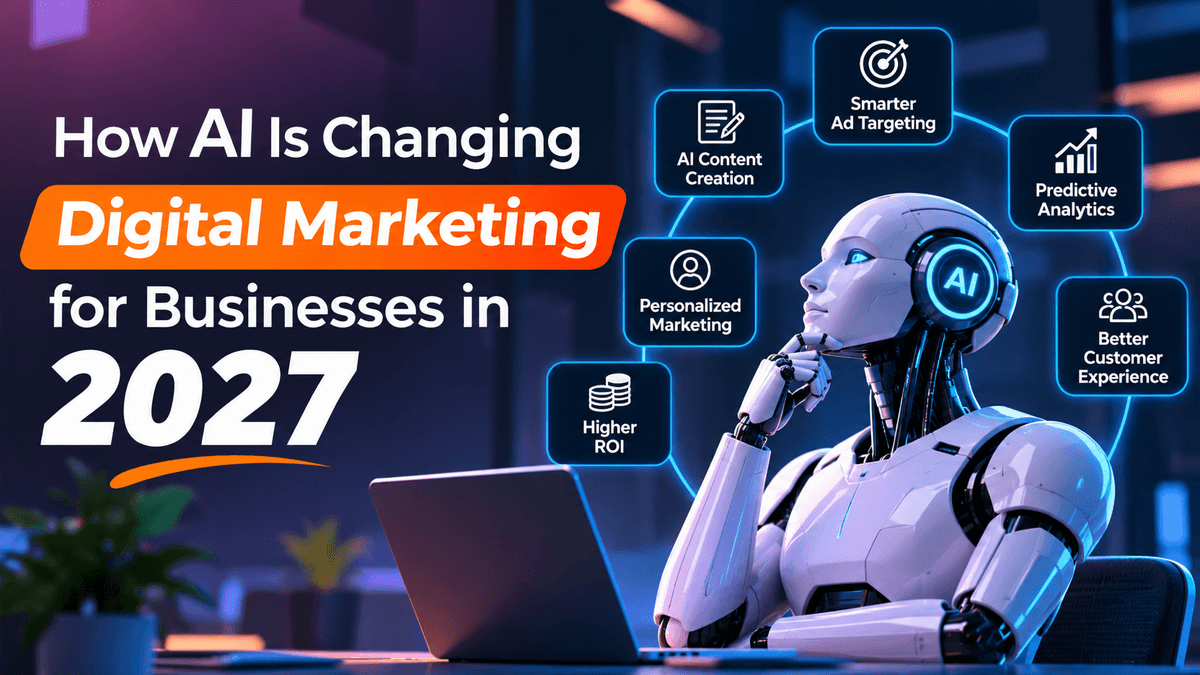
How AI Is Changing Digital Marketing for Businesses in 2027
Published: 2026-11-19 12:12:29
AI in digital marketing has moved from a nice-to-have experiment to the everyday engine behind search visibility, content, advertising and customer engagement. As 2027 approaches, businesses of every size, from a neighbourhood cafe to a national e-commerce brand, are asking the same question: how do we use AI to grow without losing the human touch that customers trust?
This guide explains how AI digital marketing for businesses is evolving, which changes matter most in 2027, where the real risks sit, and how you can build a practical plan. It is written for business owners, founders and marketing managers who want clear, honest direction rather than hype.
What Is AI in Digital Marketing?
AI in digital marketing means using machine learning, generative AI and automation to plan, create, deliver and measure marketing campaigns. Instead of relying only on manual research and gut feeling, AI systems analyse large volumes of data to spot patterns, predict behaviour and automate repetitive work.
In practice, it shows up in many places:
- Keyword research and SEO analysis
- Drafting and optimising content
- Audience targeting and bid management in paid ads
- Chatbots and automated lead follow-up
- Predictive analytics and reporting
- Personalised emails, offers and product recommendations
The key idea is simple: AI handles scale and speed, while people provide strategy, creativity and judgement.
Why AI Digital Marketing for Businesses Matters in 2027
Adoption is already widespread. Several 2026 industry roundups, compiling surveys from sources such as HubSpot and Semrush, report that a large majority of marketing teams (roughly 86% to 88%) now use AI in their work, and that around two-thirds of small and medium businesses use AI in marketing. Canva's 2026 research, as cited in industry summaries, found that most marketing leaders who use AI save at least four hours a week.
But adoption is not the same as results. McKinsey research cited in 2026 roundups found that only about 1% of businesses that have adopted generative AI consider their usage mature. Adobe's 2026 digital trends research, as cited by Supermetrics, found that fewer than half of respondents (44%) rate their data quality and accessibility as strong enough to support AI.
The takeaway for 2027 is clear. The businesses that win will not be those that simply buy the most AI tools. They will be the ones with clean data, a clear strategy and a skilled team guiding the technology.
7 Ways AI Is Changing Digital Marketing for Businesses in 2027
1. AI SEO and Search Visibility in the Age of AI Answers
Search is no longer just ten blue links. Google's AI Overviews, chat-based assistants and answer engines now summarise information directly on the results page. This changes AI SEO in three important ways:
- Entity and authority signals matter more. Clear brand information, consistent business details and trustworthy content help both search engines and AI systems understand who you are.
- Question-led content wins. Pages that answer specific questions clearly, with structured headings and FAQs, are easier for AI systems to extract and cite.
- Local relevance is critical. For service businesses, accurate Google Business Profile data, reviews and location pages remain a major visibility driver.
This is why many agencies now combine classic SEO with what is often called Generative Engine Optimization (GEO). If you want help with SEO services that cover technical, on-page, local and content optimisation, explore Promfly's SEO services.
2. AI Content Marketing: Faster Drafts, Higher Standards
Content creation is one of the most common AI use cases for both small businesses and enterprises, according to 2026 research from Supermetrics. AI can speed up outlines, first drafts, product descriptions, ad variations and video scripts.
However, the market is also moving against low-quality, mass-produced AI content. HubSpot's 2026 State of Marketing survey, as cited in industry roundups, reports that a majority of marketers (about 62.7%) believe more human-centred content is needed to compete with AI-generated material. Search engines and readers reward originality, real experience and accurate information.
The winning 2027 approach is a hybrid one: use AI for speed, then apply human expertise for fact-checking, brand voice, original insight and storytelling.
3. Hyper-Personalisation at Scale
Customers increasingly expect messages that reflect their interests, location and past behaviour. AI makes this possible without building every campaign by hand. Examples include:
- Product recommendations based on browsing and purchase history
- Dynamic email content that changes by audience segment
- Personalised landing page headlines for different ad audiences
- Send-time optimisation for emails and notifications
The caution here is data quality and consent. Personalisation only works when your customer data is accurate, well organised and collected lawfully.
4. Smarter Paid Advertising and PPC
Ad platforms such as Google Ads and Meta already use machine learning for bidding, audience expansion and creative testing. In 2027, the advantage shifts to advertisers who feed these systems well:
- Strong conversion tracking and clean first-party data
- Multiple creative variations for the algorithm to test
- Clear business goals (leads, sales, calls) instead of vanity metrics
- Regular human review of search terms, placements and budget allocation
AI can optimise delivery, but it cannot decide your positioning or offer. That still needs a marketer who understands your business.
5. AI Chatbots, CRM and Marketing Automation
Faster response wins leads. AI chatbots and automated workflows can answer common questions, qualify enquiries, book appointments and trigger follow-ups at any hour. When connected to a CRM, they help sales teams see which leads are hot, what each customer has asked and what to do next.
For businesses that manage enquiries through spreadsheets or scattered messages, a custom CRM can be a turning point. Promfly offers CRM development for lead tracking and sales automation, which pairs naturally with AI-driven marketing.
6. Predictive Analytics and Better Decisions
Traditional reports tell you what happened last month. AI-assisted analytics can help forecast what is likely to happen next: which channels are trending, which customers may churn, which products may sell out. Behaviour-analytics tools such as heatmaps and session recordings also help teams understand where visitors struggle on a website.
Predictions are never certain, so use them to guide testing and planning, not to replace judgement.
7. AI for Social Media Marketing
Social media teams use AI for content ideas, caption drafts, hashtag research, scheduling, comment moderation and performance analysis. Short-form video tools now help with editing, captions and repurposing a single recording into multiple formats.
Still, social platforms reward authenticity. Real faces, real customer stories and a consistent brand personality continue to outperform generic, automated posting.
Challenges of AI Marketing Businesses Must Plan For
AI brings real opportunity, but responsible businesses plan for the downsides:
- Accuracy and "hallucinations." AI tools can state wrong facts confidently. Always verify statistics, claims and pricing before publishing.
- Generic output. If everyone uses the same prompts, content starts to sound the same. Differentiate with original data, expert opinions and local knowledge.
- Data privacy and compliance. India's Digital Personal Data Protection Act, 2023 and similar laws abroad shape how you collect and use customer data. Get consent and handle information carefully.
- Over-automation. Customers can tell when every interaction is robotic. Keep a clear path to a real person.
- Measuring true ROI. Many businesses adopt tools faster than they measure outcomes. Define goals and track leads, revenue and cost per acquisition, not just activity.
- Brand risk. Review all AI-generated copy and creative for tone, bias and copyright concerns before it goes live.
A Practical Roadmap to Use AI in Digital Marketing in 2027
You do not need to overhaul everything at once. Follow this step-by-step approach:
- Set clear business goals. Decide whether you want more leads, higher online sales, better local visibility or stronger brand awareness.
- Audit your data and website. Check tracking, site speed, mobile experience and content quality. AI amplifies whatever foundation you have.
- Start with one or two high-impact use cases. For many businesses, these are SEO content optimisation and lead follow-up automation.
- Keep humans in the loop. Assign someone to review AI output for accuracy, tone and compliance.
- Test, measure and refine. Run small experiments, compare results and scale what works.
- Invest in a conversion-ready website. Traffic only pays off when your site is fast, clear and easy to act on.
- Partner with specialists. A good agency brings tools, experience and an objective view, so your team can focus on running the business.
Why Choose Promfly for AI-Powered Digital Marketing
Promfly is a Delhi-based software, app and digital marketing company that helps startups and established businesses grow online. According to its website, the team has more than 10 years of experience, reports 5,000+ projects delivered and cites a 98% client satisfaction rate. These are the company's own figures.
What Promfly offers businesses looking to use AI in digital marketing:
- SEO services: on-page, off-page, technical, local and e-commerce SEO, plus audits and content optimisation.
- Social media marketing: content, campaigns and community growth.
- Digital marketing growth solutions: paid ads, lead generation and conversion-focused strategy.
- Website development: fast, responsive, SEO-ready websites built with modern technologies such as React, Next.js and WordPress.
- Shopify development: online stores built for conversion, speed and SEO.
- CRM development and app development: custom systems that turn marketing leads into customers.
- Graphic design and branding, UI/UX design and content writing: visuals and messaging that build trust.
Promfly's toolkit, as listed on its website, includes widely used platforms such as Ahrefs, SpyFu, Microsoft Clarity, Yoast, Canva and ChatGPT, and the company serves industries including retail, real estate, healthcare, education, e-commerce, and food and beverages. Its digital marketing agency in Delhi NCR pages also cover Noida, Gurgaon, Ghaziabad and Faridabad. Client reviews on its website come from businesses such as Kaumo Solar, MedGlobe Health and True Gems Kart.
Ready to Grow With AI in Digital Marketing?
Whether you need a stronger SEO foundation, a high-converting website, or a complete AI-powered digital marketing strategy for 2027, Promfly can help you plan and execute it. Share your goals and get a tailored recommendation. Promfly's website states an average response time of under two business hours.
Get your free consultation today and start your AI digital marketing journey with Promfly.
Contact Promfly: Your Digital Marketing Agency in Delhi
Call Us +91 7303881503
Email Us info@promfly.com
Visit Us 2/81-82, Ground Floor, Lalita Park, Gali No - 2, Laxmi Nagar, New Delhi - 110092
Frequently Asked Questions About AI in Digital Marketing
What is AI in digital marketing?
AI in digital marketing is the use of machine learning, generative AI and automation to improve tasks such as SEO, content creation, ad targeting, email personalisation, chatbots and analytics. It helps businesses work faster and make more data-informed decisions.
How is AI changing digital marketing for businesses in 2027?
AI is changing digital marketing by reshaping search (through AI-generated answers), speeding up content production, enabling personalisation at scale, improving ad optimisation and automating lead follow-up. At the same time, it raises the bar for originality, data quality and trust.
Will AI replace digital marketers?
Unlikely. AI automates repetitive tasks, but strategy, creativity, brand judgement, relationship building and ethical oversight still need people. Marketers who learn to work with AI tools are likely to be more valuable, not less.
Is AI good for small businesses?
Yes, when used selectively. Small businesses can use AI to draft content, analyse competitors, automate replies and run smarter campaigns without large teams. Start small, measure results and keep human review in place.
How does AI affect SEO?
AI affects SEO through AI Overviews and answer engines, smarter ranking systems and new content workflows. To stay visible, businesses should publish helpful, accurate, experience-based content, use clear structure and FAQs, keep technical SEO healthy and maintain strong local and brand signals.
Is AI-generated content safe for SEO?
Google has said that it rewards helpful, high-quality content regardless of how it is produced, and it targets content created mainly to manipulate rankings. The safe approach is to use AI as an assistant, then edit for accuracy, originality and real value to readers.
How much does AI digital marketing cost?
Costs vary by scope, industry, competition and channels. Tool subscriptions can be modest, while full-service SEO, ads, content and development involve larger budgets. The best way to get an accurate estimate is to share your goals with an agency. You can request a quote from Promfly.
Which is the best digital marketing agency in Delhi for AI-driven growth?
The right agency depends on your goals, budget and industry. Look for transparent reporting, relevant case experience, verified client reviews and a clear strategy. Promfly offers SEO, social media, web development and CRM services from Delhi NCR, and you can speak with the team directly on +91 7303881503 or at info@promfly.com.
Conclusion: Turn AI in Digital Marketing Into Real Business Growth
AI in digital marketing in 2027 is not about replacing people or chasing every new tool. It is about building a strong foundation (clean data, a fast website, helpful content and clear goals) and then using AI to move faster and smarter on top of it. Businesses that combine automation with human insight will earn more visibility, better leads and deeper customer trust.
If you are ready to build an AI-powered digital marketing strategy that fits your business, get in touch with Promfly today.